
The EEGmaster curriculum and assessment framework were developed using a structured, expert-validated process aligned with competency-based neurology education principles.
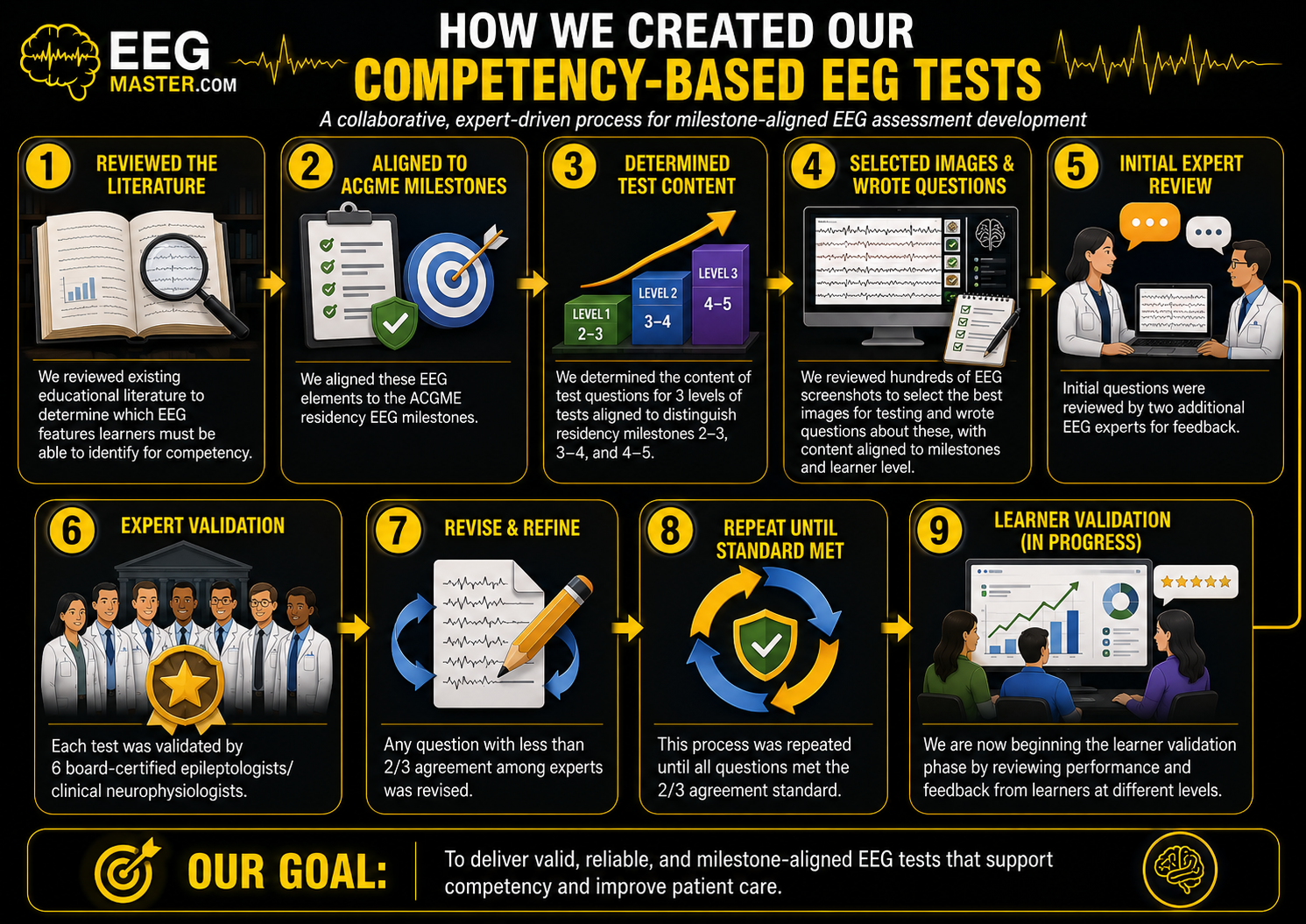
Curriculum development workflow
The curriculum was designed around competency-based medical education principles and informed by neurology residency educational milestones, clinical EEG learning objectives, and practical EEG interpretation needs. The goal was to create a structured framework capable of supporting progressive EEG competency development across training levels.
Development began with review of residency EEG educational guidelines, available educational literature, board-relevant EEG concepts, and commonly encountered clinical EEG patterns. Educational objectives were compiled and mapped to expected learner competency levels.
Review of EEG education recommendations and competency expectations.
Educational objectives organized by learner level and EEG topic.
Representative EEG examples curated for educational relevance.
Structured interpretation-based questions generated and categorized.
Hundreds of EEG screenshots and recordings were reviewed during the case selection process. Cases were selected based on educational value, clarity of findings, diagnostic relevance, and alignment with competency milestones.
Assessment questions were designed to emphasize practical EEG interpretation skills and clinically meaningful pattern recognition. Questions incorporated image-based interpretation, structured answer choices, and progressive difficulty across learner levels.
The curriculum underwent iterative expert review using a structured consensus-based validation process.
Questions and EEG examples were initially drafted and categorized according to educational objectives and competency levels.
Board-certified EEG and epilepsy specialists independently reviewed assessment content and provided scoring feedback.
Questions not meeting the predefined expert agreement threshold underwent revision and re-review.
Questions were revised iteratively until sufficient expert agreement was achieved.
Six board-certified EEG/epilepsy experts participated in the validation process. Questions failing to achieve at least 66.7% expert agreement underwent revision and repeat review before inclusion.
EEGmaster continues to undergo iterative educational refinement through real-world learner performance analysis, multicenter participation, and ongoing curriculum expansion.
Future directions include psychometric analysis, item discrimination evaluation, adaptive learner feedback, and expanded multicenter validation efforts.
We welcome collaboration from residency programs, educators, fellows, and EEG specialists interested in competency-based EEG education and assessment research.